

Through-Hole Technology Pros and Cons: How Selective Wave Soldering Machine SW-450YT Wins
Release time:
2026-10-19
Through-Hole Technology Pros and Cons and Selective Wave Soldering Advantages of SW-450YT
Through-Hole Technology Pros and Cons: How Selective Wave Soldering Machine SW-450YT Wins
Through-hole technology (THT) refuses to disappear. In automotive control boards, industrial power supplies, medical devices and connector-heavy assemblies, component leads are still inserted through drilled holes and soldered on the opposite side. For most EMS factories the question is no longer whether to use THT, but how to solder it efficiently, repeatably and at a competitive cost.
This article reviews the real advantages and limitations of through-hole technology, then explains how a selective wave soldering machine such as the SW-450YT turns those limitations into a controllable, high volume process.
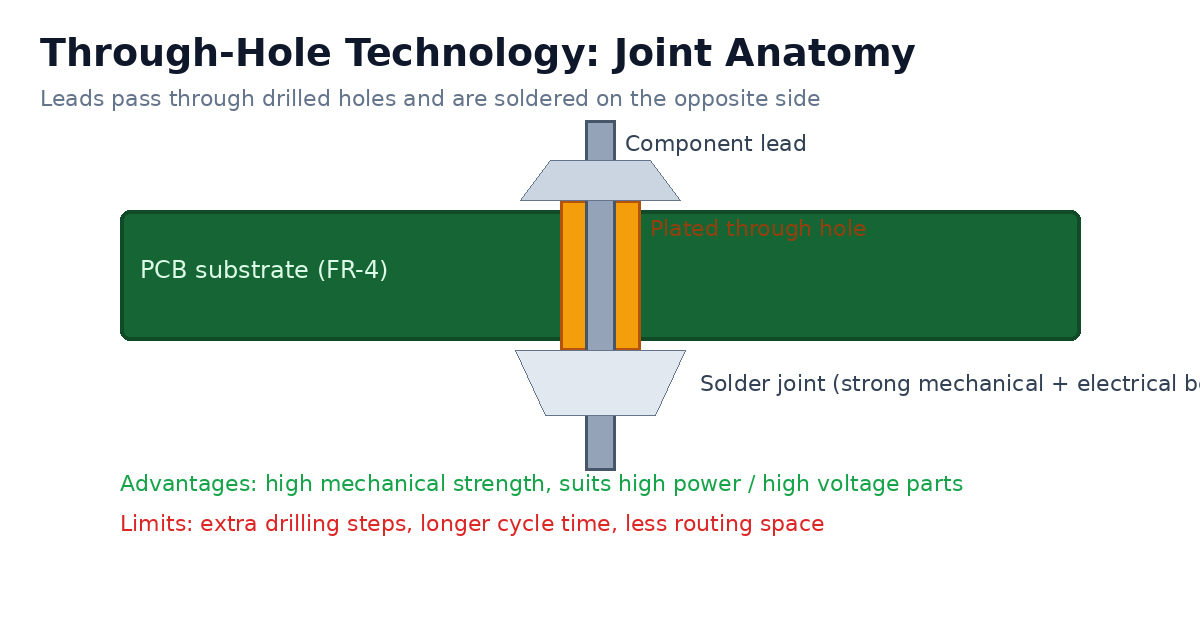
Figure 1: A through-hole joint. The lead passes through a plated hole and is soldered on the opposite side, creating a strong mechanical and electrical bond.

The Advantages of Through-Hole Technology
- Strong mechanical bond. A lead that passes through the board and is soldered on both sides resists vibration, pull force and thermal cycling far better than a surface mount pad. This is why transformers, connectors and terminal blocks are still through-hole parts.
- High power and high voltage capability. Larger solder fillets and heavier leads handle higher current and voltage without the current density limits of small SMD joints.
- Environmental durability. THT assemblies tolerate extreme acceleration, humidity and temperature swings, which is why aerospace, military and automotive electronics continue to rely on them.
- Simple prototyping and repair. Components can be inserted, replaced and reworked with basic tools, which keeps NPI and field service practical.
The Disadvantages of Through-Hole Technology
- Drilling cost and cycle time. Every hole adds drilling, plating and inspection steps, lengthening production time and raising board cost.
- Less routing space. Holes and their keep-out areas consume surface and inner layer area that could otherwise carry signal traces.
- Labor intensive soldering. Manual iron soldering depends on operator skill, and quality drifts between shifts.
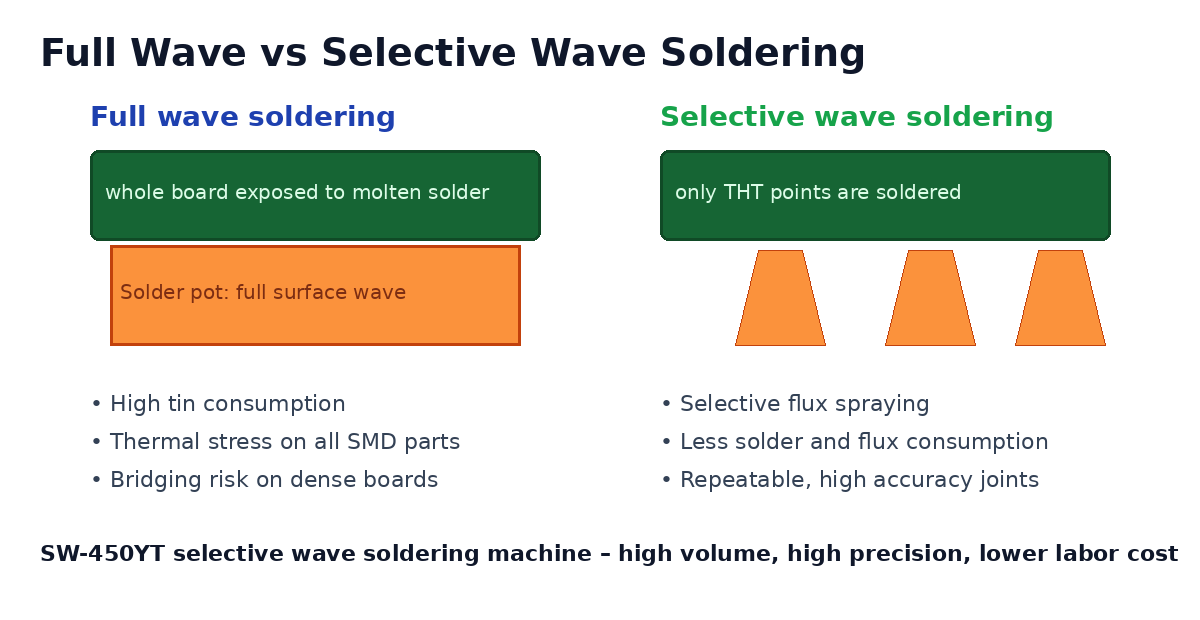
- Thermal stress in full wave soldering. Dipping the whole board exposes nearby SMD parts to molten solder, causing bridging, shadowing and rework.
How Selective Wave Soldering Solves the THT Problem
Selective wave soldering keeps the mechanical strength of THT while removing most of its cost and quality penalties. The SW-450YT is built around three practical advantages.
1. Selective flux spraying
Instead of flooding the whole board, the machine sprays flux only on the through-hole areas that will be soldered. Flux consumption drops, ionic contamination is reduced, and SMD parts outside the soldering zone stay clean and dry. Combined with local nozzle soldering, the result is a controlled solder joint exactly where the design requires it.
2. Lower labor cost
Manual iron soldering needs experienced operators and constant quality supervision. The SW-450YT runs a programmed cycle: flux, preheat and solder are applied automatically, and the operator only loads and unloads boards. Factories typically reassign two to three soldering operators to other stations after switching, and joint quality no longer depends on individual skill or shift.
3. High volume with high accuracy
The motion system repeats the same path and the same solder dwell time on every board, so joint height, fillet shape and wetting stay consistent from the first piece to the ten thousandth. That repeatability is what makes THT compatible with high volume batch production rather than batch-by-batch manual work.

SW-450YT at a Glance
| THT production challenge | How the SW-450YT responds |
|---|---|
| Flux applied across the entire board | Selective flux spraying targets only through-hole areas, saving material and protecting SMD parts |
| Skilled manual soldering, rising labor cost | Automatic flux, preheat and soldering cycle; operator only loads and unloads |
| Quality varies between operators and shifts | Programmed path and dwell time deliver repeatable joints |
| Mixed batches slow to change over | Stored programs allow fast switching between board models |
| Full wave soldering damages adjacent SMD | Local nozzle soldering keeps heat inside the THT zone |
Conclusion
Through-hole technology remains the right choice wherever mechanical strength, power handling and long term reliability matter. Its weaknesses are process weaknesses, not design weaknesses. With selective flux spraying, automated cycling and repeatable motion control, the SW-450YT removes the labor and quality penalties that used to come with THT and makes high volume through-hole production predictable.
If your line still relies on manual iron soldering or full wave processing for mixed SMT/THT boards, send us your board drawing and soldering points. Our engineers will confirm the nozzle configuration, fixture design and cycle time for the SW-450YT.
For mid-sized and high-volume EMS and OEMs navigating tight production margins and growing demand for rugged, mixed-technology electronics, the SW-450YT delivers a faster return on investment than many alternative through-hole soldering solutions. Unlike custom semi-automated setups that require months of integration and iterative process tuning, the SW-450YT is designed for plug-and-play compatibility with most standard mixed SMT/THT assembly lines, with most production teams achieving full rated output within one week of installation.
It also supports configurable full process traceability, logging flux application volume, preheat temperature, and solder dwell time for every individual joint to meet the strict documentation requirements of IATF 16949 automotive quality standards and ISO 13485 for medical device manufacturing — a critical compliance feature entirely missing from manual soldering lines. Even with consistent daily high-volume operation, the machine requires only minimal routine maintenance, with easily accessible replaceable nozzles and an automated self-cleaning system that cuts unplanned downtime. According to aggregated data from our installed base, factories switching from manual soldering or outdated full wave processing see an average 15-25% reduction in total per-board production cost, when accounting for lower labor, less rework, and reduced post-soldering cleaning requirements.
Recent Posts

CONTACT US
SHENZHEN HANSOME TECHNOLOGY CO.,LTD.
3rd Floor,Building A,Sha Tang Bei Fang Yong Fa Industrial Area,Sha Jing, Bao an, Shenzhen, China
Quick Contact HSTECH
Our team will feedback you in 2 hours

SAF Coolest v1.3.1.1 设置面板 TTMSX-AHTB-NZAWE-ZFS
无数据提示
Sorry,There is currently no content in the current column!
You can view other columns or return to Home